
Empire Clocks
-
 Sold
SoldRichly ornamented Empire vase-shaped mantel clock with Roman soldier busts
-
Important mythological Empire mantel clock “Venus guided by Love” attributed to André-Antoine Ravrio
-
Sold
Mythological Empire mantel clock “Iris attaching her wings” signed Thomire
-
Mythological French Empire mantel clock “Venus disarming Amor”
-
Sold
Exceptional Empire mantel clock “Allegory of wisdom” with Prudentia
-
Sold
Important Empire mantel clock “Allegory of the Arts and Sciences” signed Bourdier
-
Sold
Mythological Empire clock “Au char de Vénus” after design by Jean-André Reiche
-
Sold
Superb Empire mantel clock “The astronomy lesson” attributed to Claude Galle
-
Sold
Exceptional Empire mantel clock “Allegory of Arts and Sciences” with Apollo
-
Sold
Spectacular Empire mantel clock “Odysseus” signed Thomire and Moinet
-
Sold
Important Empire clock “Love makes Time pass” attributed to Claude Galle
-
Sold
Extraordinary mythological Empire clock “Hera with peacock”
-
Sold
Splendid Empire chariot clock “Allegory of Day and Night”
-
Sold
Fabulous Empire clock “Chariot of love drawn by doves” signed Bergmiller
-
Sold
Extremely rare Empire mantel clock “Eros and Psyche” attributed to Ravrio
-
Sold
Important Empire period clock “Allegory of Meditation” signed Claude Galle
-
Sold
Important Empire mantel clock “Lettre d’Amour” by François-Louis Savart
-
Sold
Refined Empire mantel clock “l’Inquiétude maternelle”
-
Sold
Important Empire period mantel clock “l’Inspiration”
-
Sold
Fabulous mythological Empire clock “Ceres at the harvest time”


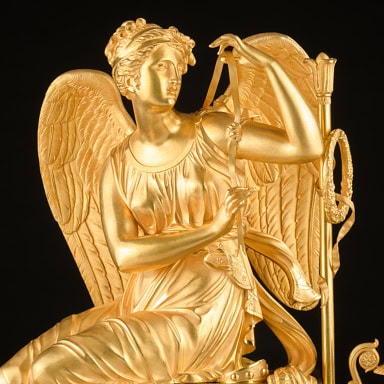
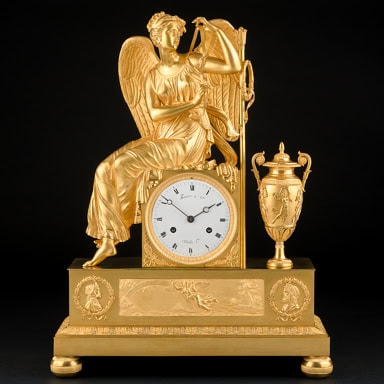


French Empire Mantel Clocks
Buying French Empire clocks
Apollo Art & Antiques is specialist in fine French antique clocks from the 18th century to the 19th century. Discover our French Empire mantel clocks.
We present a fine selection of French Empire mantel clocks for you to buy. In our collection you will find chariot clocks, mythological clocks, and other mantel clocks.
We are at your disposal to give more information about our products. So please contact us using the contact form on our page.
Empire mantel clocks: works of art
French Empire mantel clocks are among the most elegant creations in horology. Especially any Empire clock made by masters like Claude Galle or Pierre-Philippe Thomire. Marrying refined craftsmanship with classical grandeur, they are not merely timepieces but striking works of art that reflect the opulence of early 19th-century France.
Emerging during Napoleon Bonaparte’s reign, the Empire style drew inspiration from Greco-Roman antiquity, favouring symmetry, proportion, and splendour. Empire clocks embody this aesthetic through their architectural forms, rich gilded bronze ornamentation, and luxurious materials such as marble, alabaster, and crystal.
A hallmark of these pendules is the extensive use of fire-gilded bronze (also called mercury gilded bronze or ormolu) , often featuring mythological figures, animals, floral motifs or classical columns. Their dials, typically of enamel or porcelain, were delicately painted with Roman or Arabic numerals, and their movements crafted by master horologists were renowned for precision and artistry.
Themes ranged from classical mythology to Napoleonic history, each clock telling its own story through symbolic design. Today, these exceptional pieces remain treasured for their historical resonance and timeless beauty.
Often an Empire clock was accompanied by a matching pair of candelabra or candlesticks to form a clock set.